Showing posts with label French Bulldog breed. Show all posts

Boston Terrier vs French Bulldog

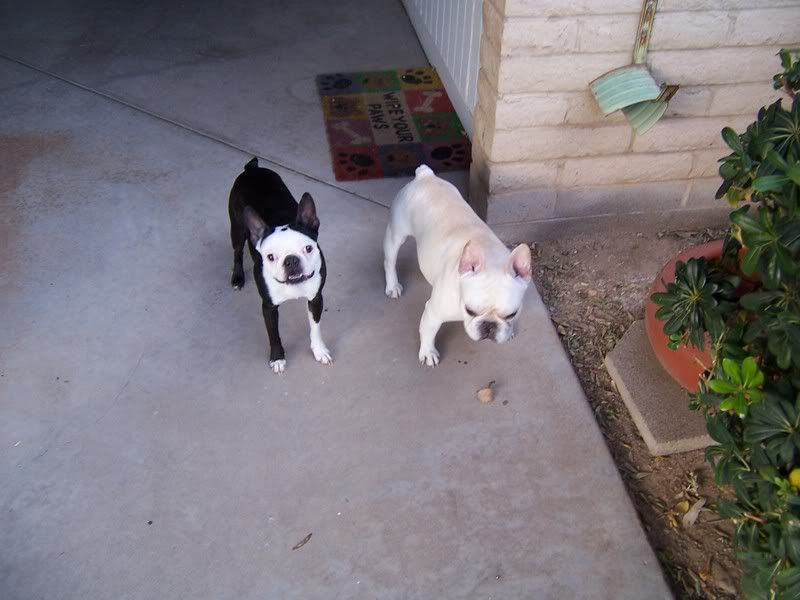
What do a smart stylish dog and a sweet natured clown dog have in common? Beside their batlike ears, Boston terriers and French bulldogs  also share the same forefather—Bulldog. On appearance and temperament, they do share many similar qualities however they require different type of owner. Both Bostons and Frenchies are great people pleasers however Bostons are ideal family dogs while Frenchies are more of the monogamy type (only bond with one person) of dogs.

This is not to say you can’t have one of each living in the same household. You may need to make some adjustments and give proper trainings.


Boston Terrier vs. French Bulldog

BreedBoston TerrierFrench Bulldog
Country of OriginUnited StatesFrance
AKC / KC GroupsNon-Sporting Group / Utility GroupNon-Sporting Group / Utility Group
Original FunctionCompanionCompanion


 French bulldog

 Physical Appearance

Coat ColorBrindle, seal, or black with even white markings—should be on muzzle, between eyes, blaze collar, forechest, and part or whole of forelegs and hindlegs.Brindle, fawn, or pied (predominantly white with brindle markings.
Coat TypeShort and smoothShort, soft, and close lying
HeadSquare wrinkle free skull, jaw, and muzzle. The muzzle is deep and short, with a black nose.Very large, with a pushed-in muscular appearance and wrinkle skin. The upper lip hang low over the sides of the lower jaw.
EyesLarge, round, and set wide apart. Dark brown in color.Set low and far apart. Round and very dark brown.
EarsSmall, thin, erect, and set at the corners of the skull.Big batlike ears but thin in texture.
BodyCompact and quite muscular with a short back and loins. Chest is deep and wide.Wide body, heavy bone, muscular build. Deep chest and short back, arched over narrow loins and hindquarters.
TailSet and carried low. Short and either straight or twisted.Set and carried low. Tapers rapidly to a point from a wide base.
Height15 – 17 inches11 – 13 inches
Weight10 – 25 lbs. Three groups—15 lbs and under, 15 – 20 lbs, and up to 25 lbs.24 – 28 lbs


Temperament, Needs, and Learning

Overall TemperamentVery affectionate, lively, and intelligent.Deeply affectionate, Sweet, amiable, easy going, adaptable
General ActivityModerateModerately low
Exercise RequirementNeeds daily exercises consist of short walks and free romp either indoor or in the yard.Moderate. Short walks and romp in the park
Grooming RequirementIt’s an easy care coat with minimal shedding, needs only weekly brushing to remove dead hair. The face should be cleaned daily with a damp washcloth.It’s an easy care coat with minimal shedding, needs only weekly brushing to remove dead hair. The face should be cleaned daily with a damp washcloth.
Ideal Home EnvironmentDue to its compact size, Boston terrier is an idea companion for city dwellers. However, he’s willing to stay with any homeowners who’d offer a spacious and shady yard.Very flexible dog. Apartment or house with a shady yard.
Ideal OwnerOwner with a semi-active lifestyle. Must be affectionate, gentle, and patient. i.e. family with children and elderly.Frenchies need human companionship constantly. A “monogamy” kind of dog. Seniors or SOHOs or owners who can take dogs to work.
Special NeedsCan be very vocal. So early training is advisable.Can become a couch potato. So give plenty of mental and short duration of physical activities.
Intelligence / RankingModerate / ranked no.54Moderately low / rank no.58
TrainabilityVery strong-minded and a little stubborn but learn readily. Will only engage in activities that appear fun and interesting to them.Quite easy to train (if you make the training more like games) as long as you don’t expect collie-style of intelligent and standards.
Cold / Heat ToleranceExtremely low / extremely lowmoderately low / extremely low

Behavior

ExcitabilityModerateLow
PlayfulnessHigh. Loves games and people pleaser.Moderate
Demand for AffectionModerately high.High
Watchdog BarkingExcellent barker (on demand). Love the sound of his own voice yet quiet at the same time.Low
ProtectionLowLow
Dominance Over OwnerLowLow
Good With DogsGreat with other dogs at home but sometimes may be aggressive toward strange dogs.Moderately well. However, some males can be very territorial.
Good With PetsModerately well.Excellent. Occasionally may chase cats.
Good With ChildrenGet along very well with children of any age group.Moderately well. If your Frenchie is devoted to you, he may not be so willing to take commands from your children or vice versa.
Good With StrangersReservedVery reserved.
Problematic AreasLike all brachycephalic (short-faced) breeds, Bostons may have breathing difficulties when exposed to heat or over exertion.Similar to Bostons and all short-nosed breeds, Frenchies snore and may wheeze and drool.

Health

Life Span12 – 16 years11 – 12 years
Major AlimentsBrachycephalic syndromeBrachycephalic syndrome, spinal disc trouble
Minor AlimentsPatellar luxation, allergiesPatellar luxation, hemivertebra
Recommended FoodBeef, fishBeef, wheat, oats

How to Care for a French Bulldog By Melissa Maroff


Affectionate, playful, comical, curious and alert--all sound like prerequisites for the perfect mate. And all aptly describe the French Bulldog. "Frenchies," as they are nicknamed, were originally bred from English Bulldogs and French Terriers, and have a personality and needs all their own. Here are some ways to care for this delightful dog with the bat-like ears.
  • Spay or neuter your French Bulldog. Spaying females before the first heat prevents breast cancer and decreases the chance of uterine infections. Neutering male dogs before age four prevents testicular cancer, helps maintain a healthy prostate and curbs aggression.
  • Take your Frenchie for regular medical checkups and stay current on vaccinations, flea and heartworm preventative. You can also do a monthly home exam of the skin, eyes, ears, nose, teeth and gums.
  • Have your French Bulldog's teeth cleaned professionally on a periodic basis. Certain veterinarians and pet teeth-cleaning professionals offer anesthesia-free cleanings. Anesthesia can be risky for a French Bulldog, due to their compromised respiratory system; however their laid-back nature permits these types of procedures to be done without an anesthetic.
  • Keep your French Bulldog at a healthy weight. Overweight Frenchies are likely to experience a swollen abdomen and breathing trouble. Feed a quality, grain-free or low grain, natural dog food (dry or canned) containing real meat and/or vegetables or a balanced natural diet of real meat and other fresh foods, which will result in less gassiness. Raw diets also work well for French Bulldogs.
  • Take your Frenchie for daily walks. They are good for apartment life and can be active indoors, but still need regular exercise.
  • Brush your French Bulldog about once a week with a rubber brush or rubber grooming mitt to remove loose and dead hair. They are average shedders.
  • Clean your French Bulldog's face folds and mouth regularly with a warm, wet washcloth, since they tend to drool.
  • Bathe your French Bulldog when necessary. Usually every few months is OK. Clean the ears with a cotton ball and baby oil or ear cleaning solution for dogs. Keep your Frenchie's nails trimmed to a comfortable length (but you can skip the French manicure).

Tips & Warnings
  • French Bulldogs tend to get along with other dogs, but some may be dog aggressive if not properly socialized. They normally get along with cats.
  • Frenchies get along with strangers and love every family member, but normally bond most with one person.
  • French Bulldogs are better with older children, because they don't tolerate rough play well.
  • Frenchies thrive on human companionship and won't do well if left alone for too long.
  • French Bulldogs snort, wheeze, grunt and snore loudly. That's all normal.
  • French Bulldogs can be stubborn and do better with patient, consistent training rather than harsher methods.
  • Being a flat-nosed breed, French Bulldogs are susceptible to heat stroke and don't do well in extreme temperatures, either hot or cold. Keep them in air conditioning during the summer and supervise their outdoor activity so they don't over-exert themselves and become overheated. They are definitely indoor dogs.
  • French Bulldogs are prone to eye and respiratory problems. Some also experience joint disease, spinal disorders and heart defects.
  • Be careful around swimming pools. Most French bulldogs are not able to swim.

French Bulldog Breed Standard


General Appearance
The French Bulldog has the appearance of an active, intelligent, muscular dog of heavy bone, smooth coat, compactly built, and of medium or small structure. Expression alert, curious, and interested. Any alteration other than removal of dewclaws is considered mutilation and is adisqualification.

Proportion and Symmetry--All points are well distributed and bear good relation one to the other; no feature being in such prominence from either excess or lack of quality that the animal appears poorly proportioned.

Influence of Sex--In comparing specimens of different sex, due allowance is to be made in favor of bitches, which do not bear the characteristics of the breed to the same marked degree as do the dogs.


Size, Proportion, Substance
Weight not to exceed 28 pounds; over 28 pounds is a disqualificationProportion--Distance from withers to ground in good relation to distance from withers to onset of tail, so that animal appears compact, well balanced and in good proportion. Substance--Muscular, heavy bone.

Head
Head large and square. Eyes dark in color, wide apart, set low down in the skull, as far from the ears as possible, round in form, of moderate size, neither sunken nor bulging. In lighter colored dogs, lighter colored eyes are acceptable. No haw and no white of the eye showing when looking forward. Ears Known as the bat ear, broad at the base, elongated, with round top, set high on the head but not too close together, and carried erect with the orifice to the front. The leather of the ear fine and soft. Other than bat ears is adisqualification. The top of the skull flat between the ears; the forehead is not flat but slightly rounded. The muzzle broad, deep and well laid back; the muscles of the cheeks well developed. The stop well defined, causing a hollow groove between the eyes with heavy wrinkles forming a soft roll over the extremely short nose; nostrils broad with a well defined line between them. Nose black. Nose other than black is a disqualification, except in the case of the lighter colored dogs, where a lighter colored nose is acceptable but not desirable. Flews black, thick and broad, hanging over the lower jaw at the sides, meeting the underlip in front and covering the teeth, which are not seen when the mouth is closed. The underjaw is deep, square, broad, undershot and well turned up.


Neck, Topline, Body
The neck is thick and well arched with loose skin at the throat. The back is a roach back with a slight fall close behind the shoulders; strong and short, broad at the shoulders and narrowing at the loins. The body is short and well rounded. The chest is broad, deep, and full; well ribbed with the belly tucked up. The tail is either straight or screwed (but not curly), short, hung low, thick root and fine tip; carried low in repose. 


Forequarters
Forelegs are short, stout, straight, muscular and set wide apart. Dewclaws may be removed. Feet are moderate in size, compact and firmly set. Toes compact, well split up, with high knuckles and short stubby nails.


Hindquarters
Hind legs are strong and muscular, longer than the forelegs, so as to elevate the loins above the shoulders. Hocks well let down. Feet are moderate in size, compact and firmly set. Toes compact, well split up, with high knuckles and short stubby nails; hind feet slightly longer than forefeet. 


Coat
Coat is moderately fine, brilliant, short and smooth. Skin is soft and loose, especially at the head and shoulders, forming wrinkles.


Color
Acceptable colors - All brindle, fawn, white, brindle and white, and any color except those which constitute disqualification. All colors are acceptable with the exception of solid black, mouse, liver, black and tan, black and white, and white with black, which aredisqualifications. Black means black without a trace of brindle.


Gait
Correct gait is double tracking with reach and drive; the action is unrestrained, free and vigorous.

TemperamentWell behaved, adaptable, and comfortable companions with an affectionate nature and even disposition; generally active, alert, and playful, but not unduly boisterous.


Disqualifications
Any alteration other than removal of dewclaws.
Over 28 pounds in weight.
Other than bat ears.
Nose other than black, except in the case of lighter colored dogs, where a lighter colored nose is acceptable.
Solid black, mouse, liver, black and tan, black and white, and white with black. Black means black without a trace of brindle.

Approved June 10, 1991
Effective July 31, 1991

French Bulldog breed


The French Bulldog is a small companion breed of dog. The name suggests that France is the country of origin, but, in fact, the Americans and British may have played a larger role in the breed's development. The dogs are commonly called the Frenchie and are nicknamed "clowns" and frog dogs.

Physical description

French bulldogs are a compact companion dog, active but not sporty. They are muscular dogs with a smooth coat, snub nose and solid bone structure. Their physical appearance is characterized by naturally occurring 'bat ears' that are wide at the base and rounded at the top. Their tails are naturally short, not cropped, and can be straight or screwed, but not curly.

Under the American Kennel Club and Canadian Kennel Club standards, weight is not to exceed 28 pounds (13 kg). In general, "Frenchies" range in weight between 20 and 28 pounds. The FCI does not set a hard and fast weight limit, simply stating 'The weight must not be below 8 kg nor over 14 kg for a bulldog in good condition, size being in proportion with the weight'.

But for both FCI and US:

In its most simple forms, French bulldog coat color can be simply be described as the original pied, brindle or fawn, with a variety of possible marking patterns. The differences in appearance are all due to variants in marking patterns, which range from brindle to pied and to fawn.

Examples shown from the American Kennel Club:

Here are a few examples of common - and not so common - coat patterns and colors within French Bulldogs. All terms should be taken subjectively, as there is a great deal of difference of opinion within the Frenchie community as to which term defines which color.


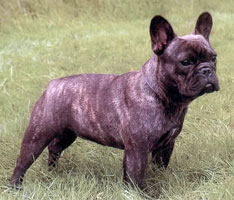
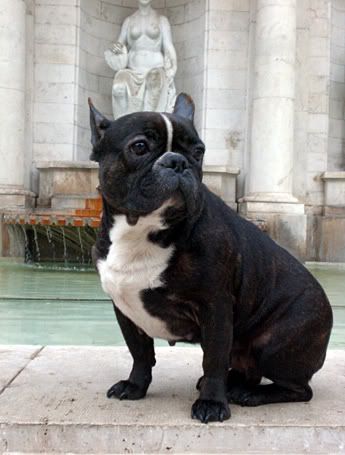
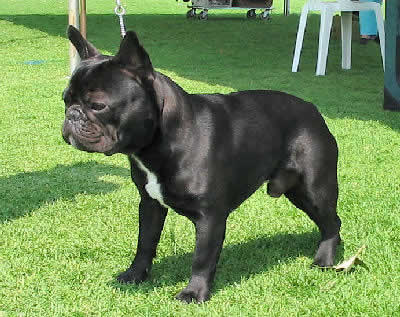
Black brindle - also known as seal brindle - so dark it may appear black, but closer inspection will reveal at least a few lighter colored hairs.


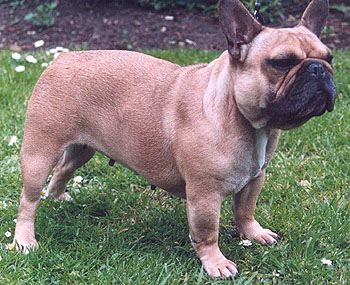
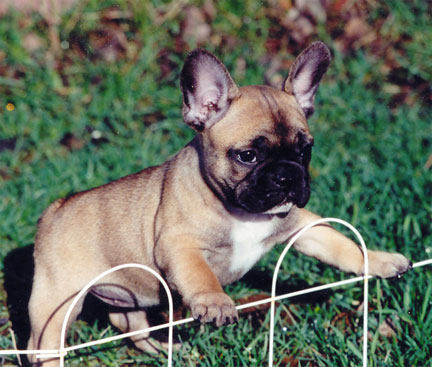
This color pattern is sometimes referred to as reverse brindle in Frenchies. It refers to the fact that fawn is more predominant than the black brindling.Also frenchbull dogs have very stiff, tall and pointy ears
Tiger brindle is a term reserved for dogs with a coat pattern comprising a fairly regular pattern of alternating fawn and black stripes, similar in appearance to the coat of a tiger.


Pale cream French Bulldog. Creams can range in hue from deep amber to rich butterscotch to palest gold. This color is generally considered to be a dilution of fawn, minus the masking gene.


This color and pattern are referred to as black masked fawn. The base color of the coat can vary in shade from red to tan. The mask refers to the marking pattern on the face.


This color and pattern are referred to as black masked RED fawn, due to the rich red hues of the fawn base coat. We have seen fawns in all shades, from brick red to honey to lemon yellow.


This pattern is referred to asbrindle pied. Brindled areas - areas where fawn is overlaid with black striping - are interspersed with areas of white coat. Markings can be slight, or predominant.


Ticked Pied. Dog has obvious freckled markings among the white areas of the body. Only The Kennel Club (UK) standard specifies 'ticking' as a DQ,but this pattern still tends to be heavily penalized in show rings everywhere.


Red fawn pied French Bulldogs. Paler versions are sometimes referred to as fawn pied, lemon pied or honey pied.


This color can be referred to as either liver or brown - each is a disqualification within the AKC or FCI breed standards. Dog has NO brindling, and is a uniform reddish - brown, with self pigmented lips, nose, pads,etc. Eyes have a yellowish hue.

This is referred to as blue, or blue brindle. Brindle markings on this dog have a "grey" hue, and base coat color is a solid blue-grey.


Blue Pied French Bulldog. "Blue" Frenchies are a result of the 'd' or dilute gene. In this form, the dilute factor has caused the black hairs to become blue. Pigment on nose and pads is also a greyish blue in color, and eyes are often blue or yellowish gold.

Blue-Fawn A variation of blue, with coloring being seen most clearly in the masking points on the face. Typically they have green/grey eyes. It is said that they are usually produced by a fawn or red fawn parent. 


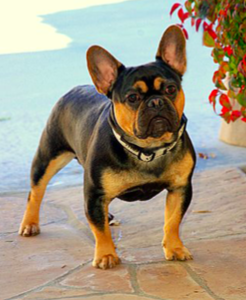
Black and tan the rarest of the french bulldog marking patterns, It has been theorized that black and tan was initially designated a dq because it is a dominant marking pattern in canines. We now know that black/tan or tan points are a recessive gene on the A series locus. there are only a few of these beautiful dogs in the whole world.
Temperament
The French Bulldog is a gentle breed that typically has a happy-go-lucky attitude. Like many other companion dog breeds they require close contact with humans. They have fairly minimal exercise needs, but do require at least daily walks. Their calm nature makes them excellent choices for apartment dwellers, as does their usually sensible attitude towards barking. As a flat faced breed, it is essential that owners understand that French Bulldogs cannot live outdoors. Their bulk and their compromised breathing system makes it impossible for them to regulate their temperature efficiently. In addition, Frenchies are top heavy and therefore have a difficult time swimming. Precautions must be taken when exercising a Frenchie during hot or humid weather, as well.

French Bulldogs can play too roughly for some smaller children, and should be monitored at all times during play. As well, children should be cautioned not to pick French Bulldogs up, as the dogs' small size can mask how heavy they are.

French Bulldogs are essentially a bull and terrier breed, and as such, it is not surprising to learn that canine aggression can sometimes occur. Generally, this takes the form of same sex aggression. Owners considering adding a second dog to their household are usually cautioned to choose one of the opposite sex. Spaying or neutering can do much to curb aggressive tendencies before they begin. The French Bulldog energy level can range from hyperactive and energetic to relaxed and laid back.

Health

There are several congenital diseases and conditions to which French bulldogs are susceptible, although they are still considered among the healthiest of the bull breeds. Frenchies can suffer from Von Willebrand's disease (VWD), a bleeding disorder that is also found in humans and is similar to hemophilia, which can impede their clotting. In conjunction to this, French bulldogs may also suffer from thyroid condition. Many breeders follow a program of testing younger dogs for VWD, and only testing for thyroid at that time if the VWD factor is low. In this program, the breeder tests thyroid again just prior to using the dog for breeding. Other breeders test both VWD and thyroid at the same time.

French bulldogs suffer from Brachycephalic syndrome, which is what creates the flat faced appearance of the Frenchie. As a result, one of the most common defects in French bulldogs is elongated soft palate or cleft palate. Puppies affected with Cleft palate are generally put down at birth, as it is generally considered to be an almost impossible condition to correct. Elongated soft palate can manifest as anything from a mild condition causing labored breathing to severe condition that can cause the affected dog to pass out from moderate exercise.

Frenchies may also have a tendency towards eye issues. Cherry eye, or everted third eyelid, has been known to occur, although it is more common in (English) bulldogs and pug dogs. Glaucoma, retinal fold dysplasia, corneal ulcers and juvenile cataracts are also conditions which have been known to afflict French bulldogs. Screening of prospective breeding candidates through CERF - the Canine Eye Registration Foundation - can help to eliminate instances of these diseases in offpsring. The skin folds under the eyes of the French bulldog must be cleaned regularly and kept dry in order to avoid fold infections. In extremely severe cases of persistent fold infections, some veterinarians have performed fold removal surgeries.

French bulldogs can also suffer from a condition called megaesophagus, a term which collectively describes several esophageal disorders and malformations in any combination from single-to-double or multiple. One of the more serious complications in a dog affected with megaesophagus is passive regurgitation, in which the affected dog vomits up food or phlegm after eating or exercise. Passive regurgitation can frequently result in aspiration pneumonia.

Another result of the compacted airway of the French bulldog is their inability to effectively regulate temperature. While a regular canine may suffer to some degree from the heat, to a Frenchie it may be lethal. It is imperative that they be protected from temperature extremes at all times, and that they always have access to fresh water and shade.

French bulldogs can also suffer from an assortment of back and spinal diseases, most of which are probably related to the fact that they were selectively chosen from the dwarf examples of the bulldog breed. This condition is also referred to as chondrodysplasia. Some breeders feel that only dogs that have been x-rayed and checked for spinal anomalies should be bred from, but this is a difficult position to take sides on. While it is true that no dog affected with a spinal disease should be bred from , there is a great deal of variance in the appearance of a French Bulldog's spine as compared to, for example, a labrador retriever. If possible, such decisions should be left to either a veterinarian or breeder who has seen quite a few bulldog breed spinal x-rays, to avoid eliminating dogs unnecessarily.

French bulldogs frequently require caesarean section to give birth. As well, many French bulldog stud dogs are incapable of naturally breeding, requiring breeders to undertake artificial insemination of bitches (female dogs). French bitches can also suffer from erratic or 'silent' heats, which may be a side effect of thyroid disease or impaired thyroid function.

Thyroid disease may also be responsible for some of the skin conditions which afflict some Frenchies. Skin allergies, obsessive foot licking, and interdigital cysts have been known to affect some French Bulldogs.